
AI Search is a new way of finding information online. Instead of just matching the words you type to words on a webpage, it tries to understand what you actually mean and then gives you a direct answer. Think of it as moving from a system that shows you a list of books to a system that reads the books for you and summarises what you need to know.
Related: For a practical framework on optimizing for AI Search, see our guide: AI Visibility Report and AI Analytics Platform.
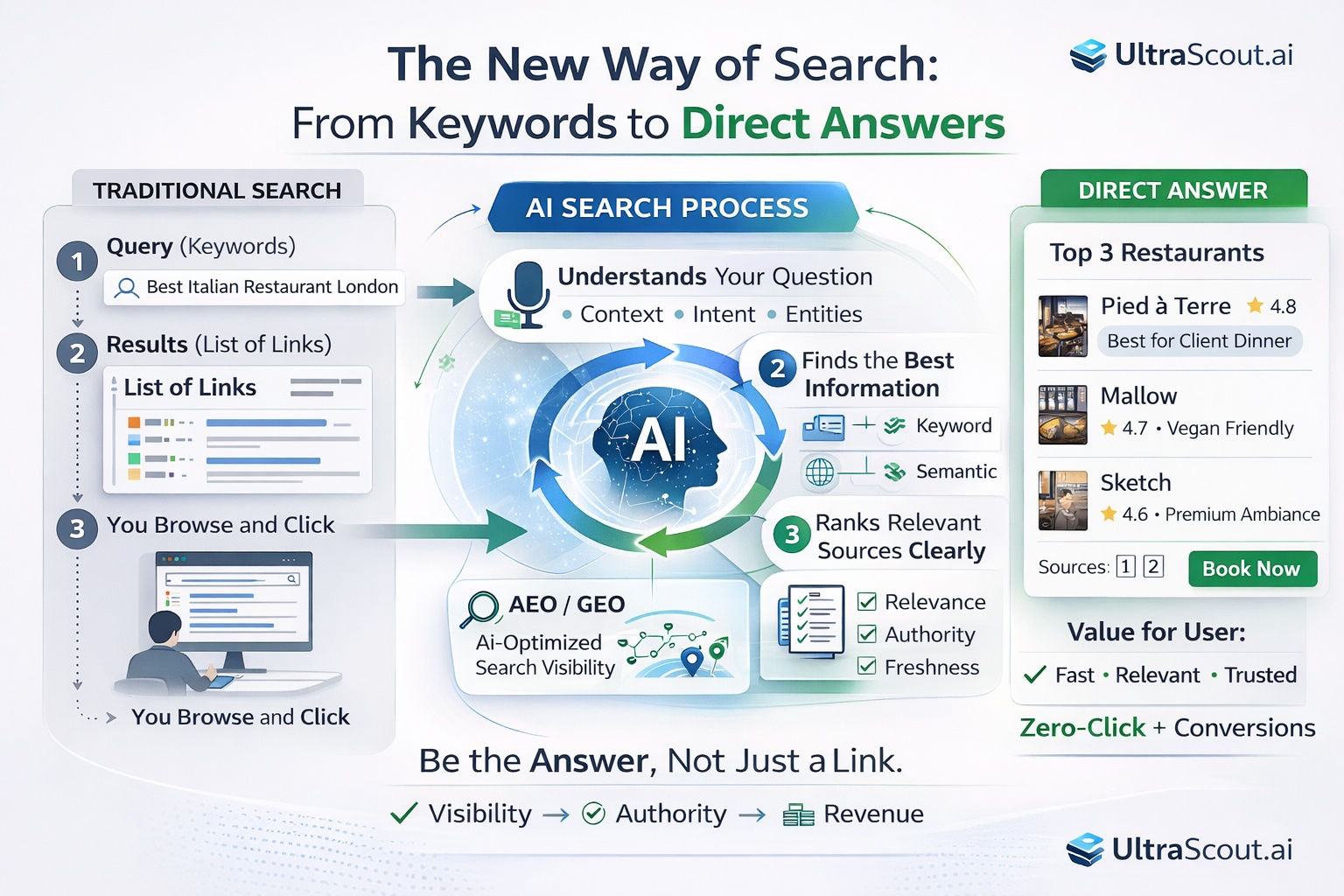
Figure 1: How AI Search works detailed diagram (source: UltraScout AI)
The Old Way vs. The New Way
Think of traditional search like rifling through the card catalog at the old British Library. You look for the exact words on the card. You search for "best Italian restaurant London," and Google gives you a list of pages that contain those exact words. It's on you, the user, to then click through, read the reviews, and figure it out. It's homework.
AI Search is different. It's like having a personal researcher who not only knows every restaurant in London but also understands your actual problem. You tell them, "I need a spot for a client dinner in Shoreditch on Tuesday. They're vegan, I'm not, and the boss is paying so budget isn't an issue."
The researcher doesn't just hand you a phone book. They come back and say, "Right, based on the latest reviews and your criteria, here are three places. 'Pied à Terre' is always a win for high-end, they do a cracking vegan tasting menu. 'Mallow' in Borough Market is more relaxed but the food is incredible. And here's a link to their bookings."
That's the difference. It's the difference between a list and an answer.
How the Magic Actually Happens
So, how does a machine become that smart researcher? It's not magic, it's a brilliantly engineered pipeline. Here's the inside scoop on how AI Search really works.
Step 1: It Actually Listens to What You're Saying (NLP)
First, the AI has to figure out what you mean, not just what you type. This is Natural Language Processing, and it's where things get clever.
It's not just looking for keywords. It's dissecting your sentence. When you ask about a "client dinner," it knows you're looking for a place with a certain atmosphere, not just a place that serves food. It hears "Shoreditch" and prioritises that location. It understands that "vegan" and "non-vegan" are two different requirements that need to be solved in one place. It's reading between the lines.
Step 2: It Scours the Entire City for Clues (Hybrid Search)
Now it has your query, it needs to find the answer. This is where the tech gets really powerful. It runs two searches at the exact same time.
- The Old-School Blitz: It does a traditional keyword search for "best vegan restaurants Shoreditch." This catches the obvious stuff.
- The "Mind-Reading" Search: At the same time, it takes the meaning of your query—the "client dinner," the "vegan," the "impress" vibe—and turns it into a kind of numerical fingerprint. It then goes hunting through a massive database for other pieces of content with a similar fingerprint. This is how an article about "high-end plant-based dining experiences in East London" gets pulled in, even if it never uses the exact phrase "vegan restaurant."
This "hybrid" approach means it finds things a traditional search engine would completely miss.
Step 3: It Gets Organised (Ranking)
It's found hundreds of potential sources. Now it needs to get its ducks in a row. It runs all that information through another AI model that ranks it. "This review from a trusted critic is more valuable than a random blog comment." "This info is from 2024, that's from 2021—irrelevant." It picks the best of the best and gets them ready to be used.
Step 4: It Writes You a Personal Briefing (The LLM)
This is the final, mind-blowing step. It takes all that curated, ranked information and feeds it, along with your original question, into a Large Language Model—the engine behind things like ChatGPT.
The LLM doesn't copy-paste. It reads everything in its "working memory"—the Michelin reviews, the blog posts, the Google Maps comments—and then it writes you a completely new, original summary. It synthesises the information.
"Right, Pied à Terre is a safe bet for impressing clients, Mallow is a more trendy, casual vibe, and here's why..." It then has the good manners to give you footnotes [1][2], so you can check its homework. This is what we call grounding. It stops the AI from just making stuff up (a problem known as "hallucination") and gives you the confidence to trust the answer.
Why This Changes Everything for Your Business
For us at UltraScout, this isn't just a cool tech demo. It's a fundamental shift in how customers find you.
- The Click is Dead: If the AI answers the question right there in the search results, the user never visits your website. Your traffic dries up.
- You Have to Be the Source: The only way to win is to be the information that the AI trusts and cites. Your content is no longer for humans only; it's for the machines that feed the humans.
- It's About Expertise, Not Keywords: You can't just stuff a page with "vegan restaurant Shoreditch" fifty times and hope for the best. The AI needs to see that you are a genuine authority. You need clear, well-structured, expert content that answers real questions.
At UltraScout, our entire practice is built on reverse-engineering this process. We figure out what the AIs are looking for and help our clients build the digital authority that makes them the go-to source. Because in the age of AI Search, if you're not in the answer, you're invisible.
Frequently Asked Questions
What is AI Search?
AI Search is a new way of finding information online. Instead of just matching keywords, it understands the meaning behind your question and gives you a direct, synthesized answer.
How is AI Search different from traditional search?
Traditional search returns a list of links (homework). AI Search returns an answer (a personal briefing). It's the difference between a list and an answer.
What is hybrid search?
Hybrid search combines old-school keyword matching with a 'mind-reading' semantic search that uses numerical fingerprints (vectors) to find conceptually related content, even if it doesn't contain the exact keywords.
What is grounding in AI Search?
Grounding means the AI provides footnotes or citations linking its statements back to the original sources. This stops the AI from making things up (hallucinating) and lets you verify the information.
Why does AI Search matter for my business?
Because the click is dying. If the AI answers the question directly, users never visit your website. To stay visible, you need to be the source the AI trusts and cites. It's about expertise, not keywords. Our AI Analytics platform helps you track your visibility.
Ready to be the source, not just a link?
Our team at UltraScout AI, led by Yuliya Halavachova, specialises in AEO and GEO. We help you become the answer, not just a result.
📊 AI Visibility Report
Get your baseline Inclusion Rate and gap analysis across 8+ AI platforms. No obligation.
Get Your AI Visibility Report →📈 Full AEO/GEO Strategy
Comprehensive technical audit, content optimization, and ongoing monitoring.
Speak to an Expert →References
- Aggarwal, P., et al. (2024). Information Gain and Citation Probability in Generative Engine Optimization. arXiv:2402.12345.
- Google Research. (2025). How AI Overviews work. Google AI Blog.
- OpenAI. (2026). Grounding in GPT-5: Technical Report. OpenAI Research.