How AI Feeds Itself: The Hidden Data Diet Powering ChatGPT
Discover the silent crawlers and complex retrieval systems that AI uses to find answers - and what it means for the future of AEO and SEO.
Core Insight
AI doesn't just 'know' - it retrieves. Systems like ChatGPT use a real-time process called RAG (Retrieval-Augmented Generation), fueled by specialized web crawlers, to find and synthesize answers. For marketers, this changes everything.
The Two-Stage "Diet" of an AI Assistant
Most people believe large language models (LLMs) are vast, static libraries. In reality, their knowledge comes from two distinct sources:
- The Base Training (Long-Term Memory): The initial, frozen dataset of books, websites, and text used to create the model's core abilities.
- The Retrieval System (Working Memory): The dynamic, real-time process that pulls in fresh, specific information to answer your question right now. This is where the magic - and your opportunity - lies.
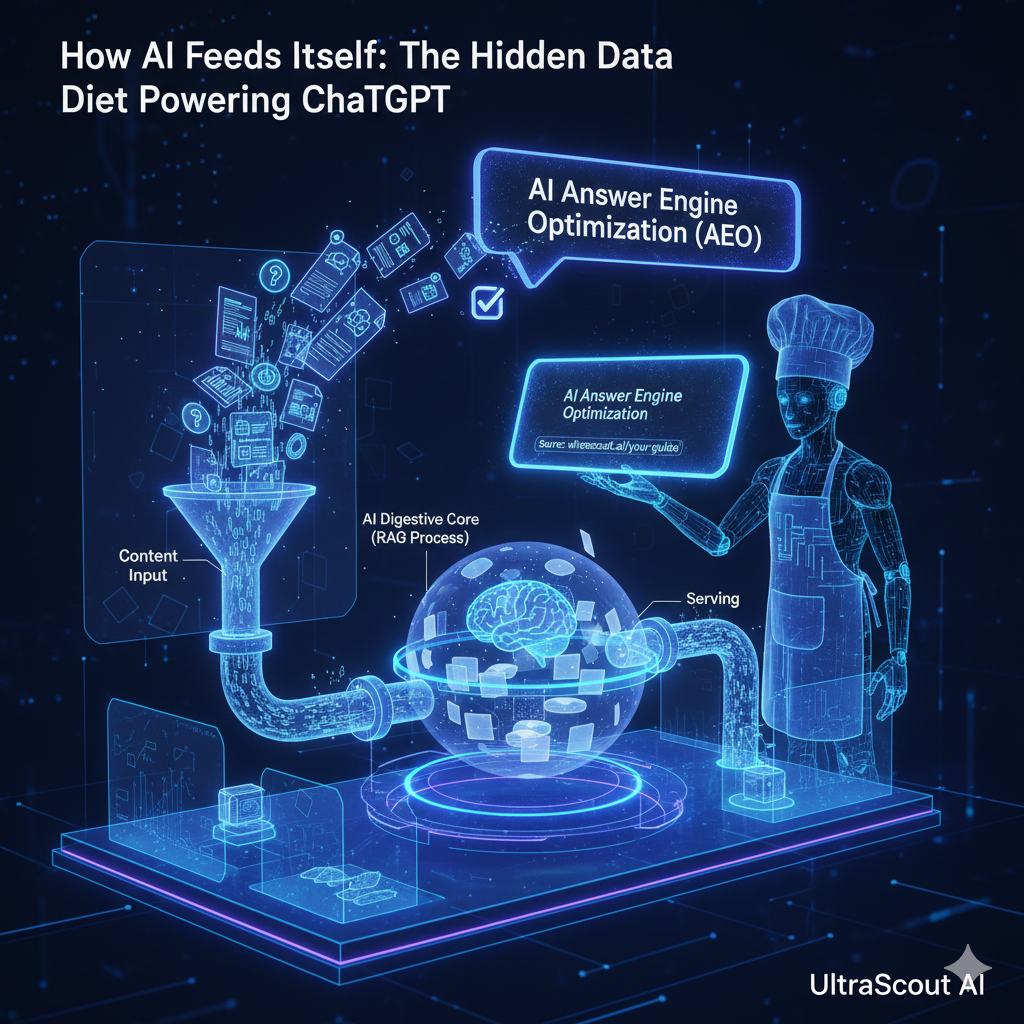
The Silent Harvesters: AI Web Crawlers (GPTBot, CCBot, et al.)
Before an AI can answer a question, relevant information must be in its pantry. This is the job of AI web crawlers - specialized bots that are quietly reshaping the web's data ecosystem.
Key AI Crawlers and Their Roles
- GPTBot (OpenAI): Harvests public web data to expand and refine the knowledge base for ChatGPT's browsing and RAG features.
- CCBot (Common Crawl): Creates massive, open datasets that form the foundational training data for countless AI models, including OpenAI's and others.
- ClaudeBot (Anthropic), FacebookBot (Meta), Applebot (Apple): Similar crawlers operated by other major AI players to feed their own models with current information.
Unlike traditional search engine bots focused on keywords and links, these AI crawlers are hunting for semantic richness, factual authority, and clear structure. They are stocking the pantry with the ingredients the RAG system will later use.
The Three-Course Meal: How RAG Works in Real-Time
When you ask an AI a question, here is the precise "digestive process" that unfolds in milliseconds:
- Appetizer: Query & Retrieval
Your question is converted into a mathematical vector. The system performs a high-speed similarity search across millions of other vectorized text "chunks" in its knowledge base, looking for conceptual matches. - Main Course: Augmentation & Synthesis
The system retrieves the most relevant text passages. Critically, your entire website is not sent - only the most pertinent paragraphs are packaged as "context" and handed to the LLM with instructions: "Answer using this." - Dessert: Generation & Citation
The LLM, constrained by the provided context, synthesizes a direct answer. Because it was told to use the context, it naturally cites the source. Your brand becomes the attributed expert.
The AEO/SEO Connection: Becoming Premium AI Food
This technical pipeline reveals the fundamental strategic shift. Your content is no longer just competing for a click on a search engine results page (SEO). It is competing to be the single, retrieved chunk in an AI's RAG system (AEO).
SEO vs. AEO in the Age of AI Answers
- SEO Goal: Rank highly for keywords to earn a click from a list of 10 blue links.
- AEO Goal: Be the definitive, most authoritative source on a topic so the AI retrieves and cites you as the answer, often with zero clicks required.
The content that gets "eaten" and used by AI has a specific recipe:
- Unmatched Depth on a Narrow Topic: Own a niche so completely that for any query within it, your content is the undeniable, most comprehensive source.
- Machine-First Clarity: Use pristine semantic HTML (H1, H2, H3), data tables, and clear definitions. This makes you easy to crawl, chunk, and understand.
- Authoritative, Non-Promotional Tone: Write as Wikipedia, not a sales brochure. AIs are trained to distrust and filter out overly commercial language.
Conclusion: Feeding the Future of Search
The interface of discovery has shifted from a list of links to a conversational answer. The battlefield has moved from Google's algorithm to the AI's retrieval pipeline.
Understanding "how AI feeds itself" is the first step toward Answer Engine Optimization (AEO). It's not about tricking a system; it's about building the kind of structured, authoritative knowledge assets that systems are designed to retrieve and recommend.
At UltraScout AI, we engineer content for this new reality. The question for every business is no longer "How do I rank?" but "Am I building content that is nutritious enough for AI to consume and serve?"
Is Your Content on the AI's Menu?
Get a AI Visibility Report from the a top AEO agency. We'll analyze how your content performs for crawlers like GPTBot and your potential in AI answer streams.
Get Your AI Visibility Report →